
By Joyell Nevins – CFFM Blogger
A Persian Queen who resided in a palace at least 400 years before Christ and a shepherd-slave who lived in the fields of Ireland in 3-400s AD – what could these two people possibly have in common?
They both were victims of circumstances they didn’t ask for, transplanted into a hostile environment, and yet they became perfectly positioned by the Lord to literally save a nation.
Those two people were Esther of the Bible and Maewyn Succat, known to the world as St. Patrick. Both have holidays celebrated in their name this season, and both of their stories call us to live with courage and trust in a God of deliverance.
In Part One, we looked at St. Patrick, celebrated on the day of his death, March 17. His life is a story of grace and bravery, humility and forgiveness, and victory through impossible odds.
An Unlikely Queen
All of those adjectives could also apply to Esther, one of two women in the Bible who has an entire book dedicated to their story (the other is Ruth).
Esther’s life reads like a Netflix series (there actually was a movie made about her, “One Night with the King,” but it took many liberties with the true events).
In her book “Women of the Bible Speak,” Shannon Bream summarizes chapter 1 and 2 of Esther like this:
“The emperor of Persia, King Xerses, hosts a great feast and summons his wife, Queen Vashti, wishing to display her beauty to the nobles. She refuses to come, and the angry king divorces her on the spot.
The king soon holds an unusual beauty contest to select a new queen. Esther is drafted [without choice] into the pageant. Her older cousin, Mordecai, who took her in as an orphan after her parents’ death, instructs her not to reveal her nationality or family.”
Esther was a Jew living in a foreign land. Her people had been scattered throughout Persia after the Babylonian exile (see the books of Ezra and Nehemiah for more background).
This “beauty contest” involved a year of living in the harem section of the palace, overseen by a head eunuch. These young women received 12 months of beauty preparations with essential oils and cosmetics, but they were also trapped without the ability to go home to their families. On top of that, they literally had one night with the king to impress him and make it to the next ‘round.’
“Thus prepared, each young woman went to the king, and she was given whatever she desired to take with her from the women’s quarters to the king’s palace.
In the evening she went, and in the morning she returned to the second house of the women…she would not go into the king again unless the king delighted in her and called for her by name.” Esther 2:13-14 NKJV
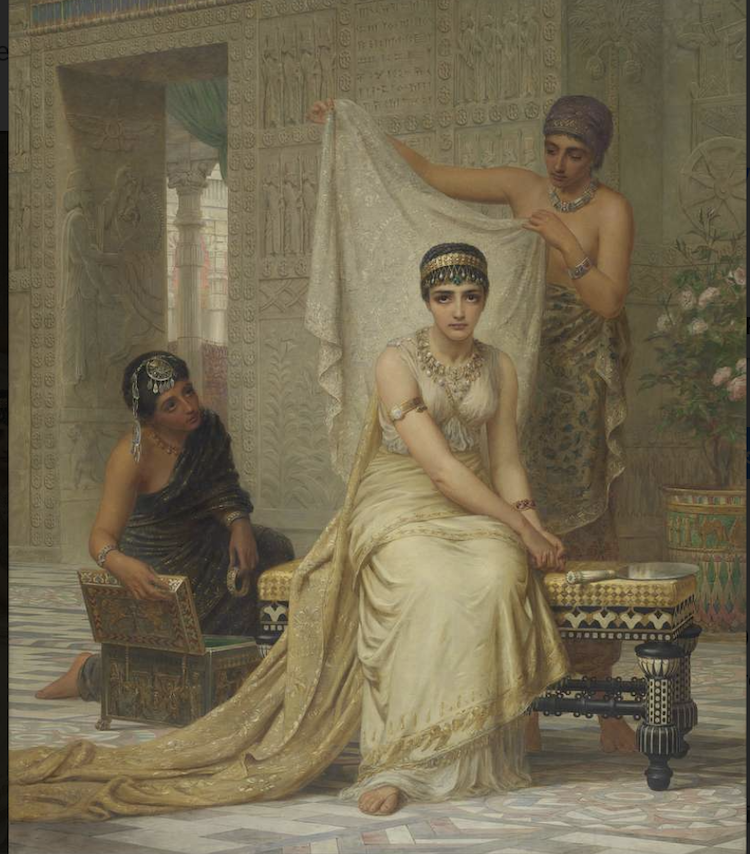
Edwin Long, Queen Esther, 1878, National Gallery of Victoria, Melbourne.
Accepting Wise Counsel
A running theme of Esther’s life is the willingness to listen to those with wisdom. She honors Mordecai’s request to not immediately tell of her Jewish heritage (which later becomes a key factor in the Jewish deliverance).
Also, even though the young women could take anything they wanted with them from the women’s quarters to their night with the king, Esther “asked for nothing except what Hegai the king’s eunuch, who had charge of the women, advised.” (Esther 2:15)
And it worked. The Lord’s favor was upon Esther, and the king stopped the beauty parade after meeting her.
“And when Esther was taken to King Ahasuerus, into his royal palace, in the tenth month, which is the month of Tebeth, in the seventh year of his reign,
the king loved Esther more than all the women, and she won grace and favor in his sight more than all the virgins, so that he set the royal crown on her head and made her queen instead of Vashti.” Esther 2:16–17 (ESV)
A People in Peril
Now Esther, an orphan from exile, is the queen of a whole nation. So, that should be the end of the story, right?
Wrong.
A new character enters the tale through the promotion of Haman the Agagite to the king’s top official. The king commands his gate servants to bow down to Haman, but Mordecai refuses.
“Bowing in the Persian context didn’t mean a slight tip of the head or a gentle curtsy. It meant full prostration. It was a gesture also familiar to ancient Jews, but with one difference: that kind of bow was reserved for God alone.
Only in the temple and only to God would a Jew make such a gesture of ultimate submission. Haman hated Mordecai because the Jewish man wouldn’t show him that kind of deference.” Women of the Bible Speak
Esther 3 describes Haman as “filled with fury,” and rather than punish Mordecai, he decides to take out his wrath on all Jews. The Jews and the Agagites, or Amalekites, had been mortal enemies since Exodus 17 (centuries after that, this was the group that King Saul was supposed to obliterate and didn’t).
Haman convinces the king that the entire Jewish population should be wiped out, and gets the king’s authority to complete the task. First though, Haman has a public announcement sent to Jews throughout the province.
“Letters were sent by couriers to all the king’s provinces with instruction to destroy, to kill, and to annihilate all Jews, young and old, women and children, in one day, the thirteenth day of the twelfth month, which is the month of Adar, and to plunder their goods.
The couriers went out hurriedly by order of the king, and the decree was issued in Susa the citadel. And the king and Haman sat down to drink, but the city of Susa was thrown into confusion.” Esther 3:13-15 (ESV)
Safe in Her Palace?
Esther discovers this news from Mordecai, who like many of the Jews was grieving the news with fasting, sackcloth and ashes.
Through messengers, she receives a copy of the edict and a request from Mordecai to plead their case in front of the king.
But there’s another law that serves as a stumbling block to this request – “if any man or woman goes to the king inside the inner court without being called, there is but one law – to be put to death, except the one to whom the king holds out the golden scepter so that he may live.” (Esther 4:11) Esther hasn’t been called to the king in over a month, so her odds of death are real.
However, just like she listened to Hagai when going into see the king, Esther heeds Mordecai’s words in this situation, too.
“Then Mordecai told them to reply to Esther, “Do not think to yourself that in the king’s palace you will escape any more than all the other Jews.
For if you keep silent at this time, relief and deliverance will rise for the Jews from another place, but you and your father’s house will perish.
And who knows whether you have not come to the kingdom for such a time as this?” Esther 4:13–14 (ESV)

Esther informs Mordecai that she will go into the king, and requests that he and his people pray and fast for her. Then, she makes this bold statement:
“…Then I will go to the king, though it is against the law, and if I perish, I perish.” Esther (ESV)
Much like Jesus hundreds of years later, Esther was willing to lay down her life for the salvation of her people.
A Scheme to Save
But she doesn’t just go in to the king for one conversation, though. Esther plans a series of private luncheons, bringing Haman in as a supposed honored guest (by the way, for another example of God’s favor and ironic sense of humor, read about an additional exchange between Haman and Mordecai in Esther 5:9 – 6:14).
At the final feast, the king asks Esther what is her wish, and tells her he will fulfill it up to half of the kingdom. This is when Esther makes her strategic move:
“Then Queen Esther answered, “If I have found favor in your sight, O king, and if it please the king, let my life be granted me for my wish, and my people for my request.
For we have been sold, I and my people, to be destroyed, to be killed, and to be annihilated. If we had been sold merely as slaves, men and women, I would have been silent, for our affliction is not to be compared with the loss to the king.”
Then King Ahasuerus said to Queen Esther, “Who is he, and where is he, who has dared to do this?” And Esther said, “A foe and enemy! This wicked Haman!” Then Haman was terrified before the king and the queen.” Esther 7:3–6 (ESV)
Wow! What an ending, laced with tension. Can you picture Esther finally speaking up about her possible demise, and then pointing straight at Haman and saying, “there’s the enemy!”
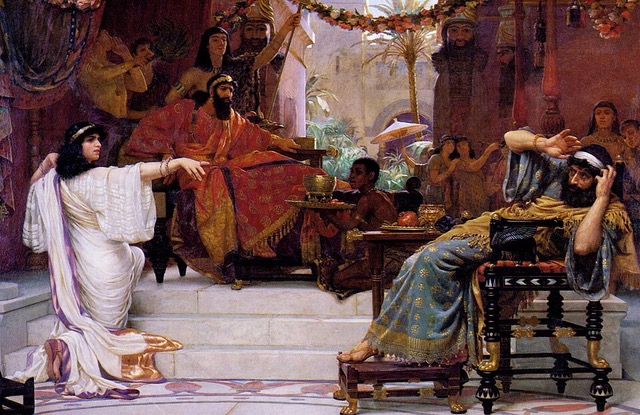 Esther Denouncing Haman (1888) Painting by Ernest Normand
The Epilogue
Esther’s courage and strength are rewarded. The king ultimately has Haman hanged on the very gallows the official had built for Mordecai. Mordecai takes Haman’s position as the king’s official, and a new edict is sent informing the Jews that they may legally fight for their lives.
“…saying that the king allowed the Jews who were in every city to gather and defend their lives, to destroy, to kill, and to annihilate any armed force of any people or province that might attack them, children and women included, and to plunder their goods,
on one day throughout all the provinces of King Ahasuerus, on the thirteenth day of the twelfth month, which is the month of Adar.” Esther 8:11–12 (ESV)
The Bible later says on that 13th day, “no one could stand against them,” both through the Persians’ fear of the Jews and the Jews’ strength to fight. By the 15th day, the Jews were able to fully rest and rejoice.
A God of the Impossible
To this day, every year on that 14th and 15th day of the 12th month (usually March), the Jewish people celebrate their victory through the holiday of Purim. The Lord is honored through joyful traditions including a feast, gift giving, costume wearing, and a special Scripture (Megillah) reading.
Just like how God worked through a set of impossible circumstances and seeming inadequacies in Maewyn Succat, or St. Patrick, to bring the gospel to the people of Ireland, so God worked through the orphan-turned-queen Esther to bring salvation to the people of Jerusalem.
“God chose a woman who had everything taken from her – her parents, her freedom, her virginity – and put her in a position of power. He used someone who, due to gender, culture, and circumstance, was invisible and uninfluential, and made her the pivotal, formidable heroine.” Rachel Friedlander, Inherit Magazine
That same God is still working today, and He can partner with you, no matter your circumstances or insecurities. We serve a God of the impossible, who delights in doing His perfect work through highly imperfect people!

So, as a fellowship leader once asked, “where or when have you seen God equip you for His glory?” What are you willing to surrender into God’s hands and see His mighty working power?
Source Referenced: